

Peak vitality after 40 is built on two pillars: the matrix that holds your body together and the biochemical messengers that direct it.
In Part 1, we explored the cellular engine: liver clearance, oxygen extraction, and glutathione reserves. In Part 2, we turn to the structural and systemic regulators of aging: your connective tissue architecture, your endocrine orchestra, and metabolic flexibility.
With precision biomarkers and modern regenerative protocols, you have more leverage than ever to maintain strong tissues, vibrant skin, and resilient metabolic health.
1. Collagen Architecture & Extracellular Matrix Integrity
Collagen is the primary structural protein scaffolding skin, joint cartilage, vascular linings, and bone matrices.
The Shift
Starting in our mid-20s, endogenous collagen synthesis drops by approximately 1% per year. After 40, this loss accelerates as estrogen and androgen levels shift and matrix metalloproteinases (MMPs)—enzymes that degrade structural proteins—become more active under the influence of UV radiation, low-grade systemic inflammation, and advanced glycation end-products (AGEs).
How To Test
- High-Sensitivity C-Reactive Protein (hs-CRP): Identifies silent, low-grade vascular and systemic inflammation that upregulates collagen-degrading MMPs.
- Fasting Insulin & HbA1c: Elevated blood glucose accelerates the formation of AGEs, which cross-link with collagen fibers, turning flexible connective tissue rigid and brittle.
- Tissue Turgor & Joint Mobility Screenings: Objective physical measurements of skin elasticity and joint range of motion.
Optimization Strategy
- Bioactive Hydrolyzed Collagen Peptides: Supplementing with 10–15 grams daily of collagen peptides delivers rich concentrations of proline and hydroxyproline, signaling dermal fibroblasts and chondrocytes to ramp up collagen synthesis.
- Enzymatic Hydroxylation Cofactors: Collagen cross-linking cannot occur without sufficient Vitamin C, bioavailable copper, and zinc; maintaining optimal levels ensures newly formed fibrils mature into durable triple-helix structures.
- Photobiomodulation (Red/Near-Infrared Light): Wavelengths between 630 nm and 850 nm stimulate cytochrome c oxidase inside fibroblast mitochondria, boosting ATP production and accelerating localized collagen repair.
2. The Endocrine Symphony: Hormonal Balance After 40
Hormonal health in midlife is not about randomly supplementing single compounds; it is about restoring equilibrium across interconnected endocrine axes.
The Shift
- Sex Steroids: Women move into perimenopause with fluctuating estradiol and diminishing progesterone; men experience andropause, marked by a gradual 1% to 2% annual drop in bioavailable free testosterone and rising sex hormonebinding globulin (SHBG).
- Adrenal Tone: Dehydroepiandrosterone (DHEA)—the foundational protective and anabolic adrenal precursor—declines steadily from its peak in early adulthood (adrenopause).
- Insulin Sensitivity: Peripheral tissues gradually become less sensitive to glucose uptake, requiring higher baseline insulin output to maintain normal glycemic levels.
How To Test
- Comprehensive Blood Steroid Profile: Measures Total & Free Testosterone, DHT, Pregnenolone, Estradiol (E2), Progesterone, DHEA-S, SHBG, and LH/FSH.
- Complete Thyroid Panel: TSH, Free T3 and total T3, Free T and Total T4, and Reverse T3 (to pinpoint issues with peripheral conversion of inactive T4 to active T3). And test for antibodies to your thyroid gland.
- Fasting Metabolic Trio: Fasting Glucose & Insulin (optimal target: < 6), and HbA1c to assess early insulin resistance long before standard pre-diabetes thresholds are reached.
Optimization Strategy
- Skeletal Muscle as an Endocrine Organ: Progressive resistance training 3-4 days per week stimulates the contraction-mediated translocation of GLUT4 glucose transporters, supports free testosterone, and secretes beneficial metabolic myokines.
- Circadian Rhythm & Adrenal Realignment: Consistent sleep windows, early morning sunlight exposure, and adaptogenic botanicals (such as Withania somnifera or Rhodiola rosea) normalize the diurnal cortisol curve.
- Physician-Guided Bioidentical Hormone Therapy (BHRT): When indicated by testing and clinical symptoms, bioidentical hormone replacement preserves lean muscle mass, maintains bone mineral density, and provides critical neuroprotection.
Your Midlife Biomarker & Action Blueprint
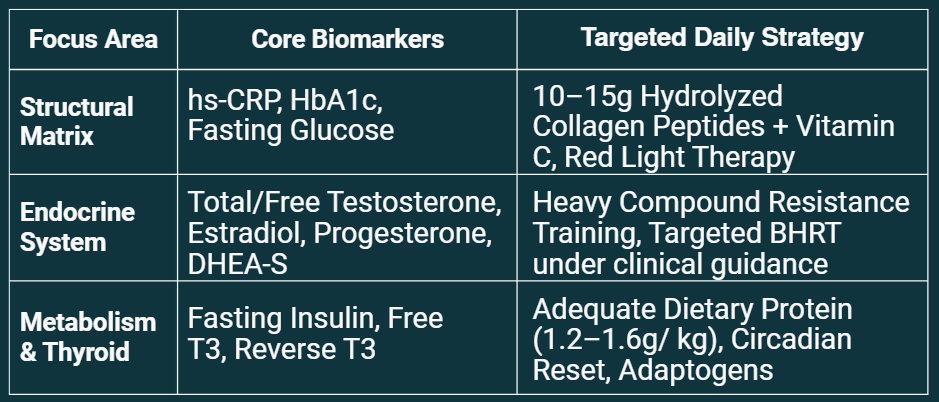
Aging after 40 is not a predetermined decline. By understanding your laboratory data and pairing it with targeted regenerative nutrition, smart movement, and hormone optimization, you can make your next decades your strongest and most energetic yet.
Advanced Functional Diagnostics:
- Advanced Functional Diagnostics:
- DUTCH Complete Panel (Dried Urine Testing for Comprehensive Hormones): Evaluates 24-hour diurnal free cortisol and cortisone rhythms, comprehensive estrogen clearance pathways (2-OH, 4-OH, 16 OH metabolites), androgen breakdown pathways (DHEA, testosterone, DHT), and organic acid markers for oxidative stress and neurotransmitter balance.
- Essential Blood Biomarkers: Complete thyroid panel (TSH, Free T3, Free T4, Reverse T3), fasting metabolic trio (Glucose, Fasting Insulin, HbA1c), and systemic inflammation via hs-CRP.
- Targeted Supplement Regimen
- Estrogen Modulation & Vasomotor Support (Hot Flashes & Night Sweats
- Black Cohosh (Actaea racemosa): One of the most researched herbs for vasomotor symptom relief, sleep disruption, and mood fluctuations without exerting direct estrogenic effects on uterine tissue.
- Red Clover (Trifolium pratense): Rich in isoflavones (phytoestrogens) that weakly bind to estrogen receptors (favoring ER-beta), helping buffer sharp estrogen drops during perimenopause.
- DIM (Diindolylmethane): Derived from cruciferous vegetables; promotes favorable estrogen clearance via the protective 2-hydroxyestrone pathway rather than the proliferative 16-hydroxy or reactive 4-hydroxy pathways.
- Progesterone Support & Cycle Regularity
- Chasteberry / Vitex (Vitex agnus-castus): Indirectly supports the corpus luteum and natural progesterone production by modulating prolactin secretion from the pituitary gland. Best suited for early perimenopause or luteal-phase deficiency.
- Adrenal Resilience & Cortisol Regulation
- Ashwagandha (Withania somnifera): Sensoril® or KSM-66® extracts help blunt stressinduced cortisol spikes, preserving adrenal precursor reserves (like DHEA) needed for hormone synthesis.
- Rhodiola Rosea: Helps counter fatigue, brain fog, and midday exhaustion while stabilizing stress response pathways.
- Regenerative In-Clinic Therapies:
- Photobiomodulation (Red/Near-Infrared Light Therapy): Targeted 630–850 nm sessions designed to upregulate cytochrome c oxidase, boosting fibroblast ATP production and joint repair.
- Physician-Guided Bioidentical Hormone Therapy (BHRT): When indicated by your DUTCH profile and blood metrics, customized bioidentical hormone therapy protects bone mineral density, sustains lean muscle mass, and supports neuroprotection.
- Regenerative In-Clinic Therapies:
- Estrogen Modulation & Vasomotor Support (Hot Flashes & Night Sweats
What to Expect on Your Journey
- Test Collection (Week 1): You will complete the four-spot DUTCH collection at home over a 24-hour cycle, accompanied by a routine fasting morning blood draw at the clinic for thyroid and glycemic markers.
- Clinical Review & Protocol Tailoring (Weeks 2–3): Once the laboratory analyzes your dried urine and serum samples, your provider walks you through your hormone breakdown pathways line by line to build a personalized therapeutic plan.
- Early Functional Adaptation (Weeks 4–6): Patients typically report stabilized daytime energy, better sleep quality as nighttime cortisol normalizes, and faster post-exercise recovery.
- Structural & Cellular Optimization (Weeks 8–12+): Visible skin firmness, improved joint mobility, steady metabolic flexibility, and balanced hormone rhythms emerge. Follow-up biomarker screening assesses downstream metabolite shifts and recalibrates therapeutic doses.
Important Note on Lab Pricing: Cash Pay vs. Insurance
Smart Consumer Tip: Functional and specialty laboratory diagnostics—including the DUTCH panel—are classified as advanced laboratory-developed tests and are rarely covered by conventional commercial insurance. Furthermore, billing standard blood markers through insurance when enrolled in a High-Deductible Health Plan (HDHP) can trigger unexpected laboratory fees applied entirely to your deductible.
In the vast majority of cases, utilizing our pre-negotiated direct cash-pay pricing is significantly more transparent and considerably less expensive than running them through insurance. You can also utilize Health Savings Account (HSA) or Flexible Spending Account (FSA) funds for both cash-pay blood draws and DUTCH test kits. Check with our front desk team to compare your plan’s deductible status against our direct cash lab pricing before ordering your panel.
Your Next Step Toward Lasting Vitality
Aging is inevitable, but how your body responds to it is influenced by more than genetics. Understanding your hormones, metabolism, and structural health allows us to identify imbalances early and develop a personalized approach to supporting your long-term health.
At Lake Oswego Health Center, we combine advanced diagnostic testing, individualized treatment plans, and regenerative therapies to help you maintain strength, energy, and overall well-being through every stage of life.
Take a proactive approach to your health.
Related services: Ozone Therapy Treatments and Detoxification Support. Schedule a consultation.
